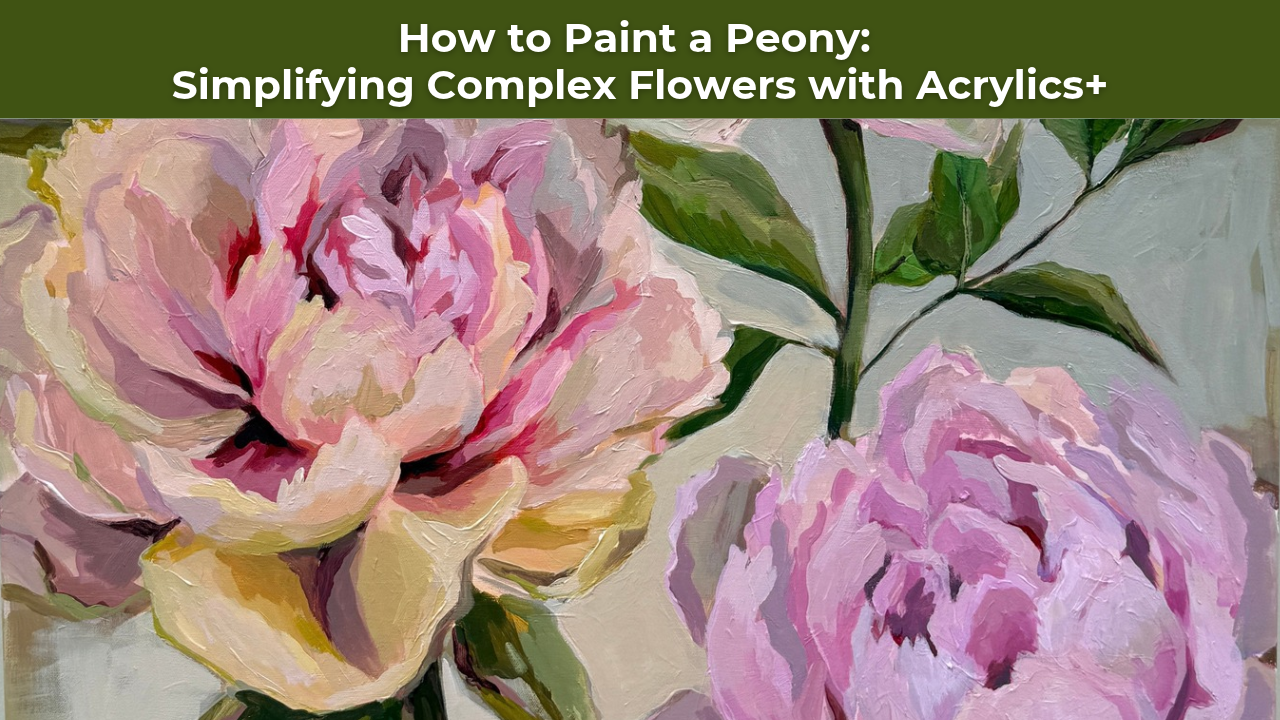
How to Paint a Peony: Simplifying Complex Flowers with Acrylics+
A peony has a lot going on.
With dozens of overlapping petals, subtle color variations, and intricate shapes, it's easy to feel overwhelmed before you even pick up your paintbrush.
But here's something I want you to remember:
You don't have to paint every petal to create a beautiful peony painting.
In fact, trying to capture every individual petal is often what makes painting flowers feel so difficult in the first place.
The secret is learning to simplify what you see.
When I taught the Pink Peony Skill Builder inside Studio B Art Club, one of the first things I told my members was to stop looking at all those individual petals and start looking for the larger shapes.
This simple shift can completely change how you approach painting complex subjects.
Why Painting Peonies Can Feel So Overwhelming
When you look at a peony, your eye naturally notices all the beautiful details.
The delicate petals.
The subtle shifts between pinks and creams.
The shadows tucked between overlapping layers.
And the way the petals curl and fold around the center of the flower.
It's tempting to think that creating a convincing painting means carefully reproducing every one of those details.
But that's not necessarily true.
In fact, focusing on individual details too early can make it harder to establish the overall structure of your painting.
You might spend time perfecting one petal only to realize that its shape or placement doesn't work with the rest of the flower.
A strong painting begins with understanding the big picture before getting lost in the details.
That's why I encourage artists to simplify their subjects into larger, more manageable shapes before worrying about the smaller elements.
Start With the Big Shapes, Not the Petals
In my Pink Peony Skill Builder, we began by identifying the larger mass of mid-tone color that made up the flower.
Rather than drawing dozens of individual petals, I looked at the overall silhouette and established a simplified shape.
[INSERT PINK PEONY BEGINNING PROCESS IMAGE]
At this stage, the painting didn't look like a finished peony.
And that was perfectly fine.
I wasn't trying to create a beautiful, detailed flower with my first layer.
I was simply establishing a foundation that I could build upon.
This is an important part of my MAP Method™, which helps artists break down complex subjects into approachable steps.
By focusing on the larger shapes first, we give ourselves a clearer understanding of the composition before introducing smaller details.
And suddenly, a flower that once felt overwhelming becomes much more manageable.
Building a Peony Painting Through Layers
Once the larger shape of the flower is established, we can begin developing the painting through layers.
Rather than trying to complete each petal individually, I like to build the entire flower gradually.
Here's how I approached the Pink Peony Skill Builder.
1. Establish the Mid-Tones
I began with the larger mass of mid-tone pink that formed the overall shape of the peony.
This gave me a foundation for the flower without getting distracted by individual petals.
At this stage, I was thinking about the general shape, size, and placement of the bloom.
2. Introduce the Darker Values
Next, I began adding darker pinks and subtle shadows to establish depth.
These darker areas helped suggest where petals overlapped and where the flower folded inward.
Rather than outlining every petal, I used darker values to create separation between the larger shapes.
This is one of the simplest ways to begin giving a flower dimension without overcomplicating the painting.
3. Add Lighter Values
Once the darker areas were established, I began introducing lighter pinks and creamy highlights.
These lighter colors helped bring certain petals forward and create the appearance of light hitting the flower.
By working from the larger shapes into smaller areas of contrast, the peony gradually began to take form.
4. Look for Subtle Color Shifts
One of my favorite parts of painting flowers is discovering the unexpected colors within them.
A pink peony isn't made up of just one shade of pink.
You might notice warmer coral tones, cooler lavender-pinks, soft creams, or deeper rosy shadows.
These subtle shifts help create variety and make the flower feel more natural.
5. Save the Details for Last
Finally, once the overall structure, values, and colors were working together, I added a few carefully chosen details.
Notice that I said a few.
You don't need to define every petal.
Sometimes just a handful of intentional brushstrokes are enough to suggest the complexity of the entire flower.
[INSERT FINISHED PINK PEONY PAINTING]
The finished painting feels detailed and dimensional, even though we never attempted to paint every individual petal.
And that's the beauty of learning to simplify.
Why Simplification Makes You a Stronger Artist
One of the biggest misconceptions about painting is that more detail automatically makes a painting better.
But often, the opposite is true.
When you learn to simplify a subject, you begin recognizing which shapes, colors, and details are actually necessary to communicate what you're painting.
You stop treating every part of your reference photo as equally important.
Instead, you begin making intentional decisions about what to emphasize and what to leave out.
This is especially valuable when painting loose, expressive florals.
Rather than creating a carefully outlined collection of petals, you're learning to suggest form through relationships between shapes, values, and colors.
And those skills extend far beyond painting peonies.
You can use the same approach when painting landscapes, still lifes, animals, or nearly any other subject.
What to Do When a Painting Feels Too Complicated
The next time you sit down to paint something that feels overwhelming, I want you to try a different approach.
Instead of asking yourself how you're going to paint every detail, ask:
What are the largest shapes I can identify?
Start there.
Then look for the darker areas.
Introduce your lighter values.
Pay attention to how the colors shift.
And finally, add the few details that will make the subject recognizable.
You don't have to solve the entire painting at once.
You simply need to figure out what needs to happen first.
The subject didn't get easier. You just gave yourself a clearer way to approach it.
And that's something you can carry into every painting you create.
Learning to Think Like an Artist
One of my biggest goals as an art educator is to help artists move beyond simply following instructions.
I don't want you to feel like you can only create a beautiful painting when someone is telling you exactly where to put every brushstroke.
I want you to understand what to look for and why.
Why certain shapes matter.
How values create dimension.
When to simplify.
And how to make decisions that strengthen your painting.
Because once you begin understanding those principles, you can approach new subjects with so much more confidence.
And that's when painting becomes especially exciting.
You're no longer just learning how to paint one particular flower.
You're developing the skills to approach almost anything you want to paint.
Learn to Paint Peonies in Studio B Art Club
If you'd like to see this process in action, my Pink Peony Skill Builder is available inside Studio B Art Club.
Throughout the lesson, I demonstrate how to simplify a complex peony using my MAP Method™, beginning with larger shapes and gradually building the flower through layers of color, value, and expressive brushwork.
Inside Art Club, you'll find a growing library of step-by-step acrylic painting tutorials and Skill Builders designed to help you develop the foundational skills and confidence to create paintings that feel uniquely your own.
Whether you're just beginning your painting journey or looking to strengthen your existing skills, I'd love to paint alongside you!
Want More Weekly Art Tips?
If you found this helpful, you’ll love our exclusive weekly art tips delivered straight to your inbox! Sign up below to get insights, painting techniques, and creative inspiration—plus first access to exciting opportunities inside Studio B.
We hate SPAM. We will never sell your information, for any reason.