How to Paint Loose, Natural-Looking Flowers with Acrylics
One of the most common mistakes artists make when painting flowers is trying to make every petal look perfect.
We carefully shape each petal, space them evenly around the center, and try to make everything look balanced and symmetrical.
But here's something I want you to remember:
Nature isn't perfect. So your petals shouldn't be either.
When you look closely at a real flower, you'll notice that the petals rarely follow a perfectly predictable pattern.
Some overlap. Some are shorter. Some bend in unexpected directions. Others practically disappear behind neighboring petals.
And those little irregularities are exactly what make a flower feel natural.
Learning to embrace those imperfections can completely change the way you approach floral painting, especially if you're trying to develop a looser, more expressive style.
Why Perfect Petals Can Make Your Flowers Look Stiff
When we're learning to paint flowers, it's tempting to simplify them into a series of identical shapes.
Take a sunflower, for example.
At first glance, it might look like a large circle surrounded by evenly spaced yellow petals.
But when you study a real sunflower, you'll discover something much more interesting.
The petals vary in length, width, and direction. Some overlap one another, while others twist or bend away from the viewer.
Some have crisp, clearly defined edges, while others seem to disappear into the surrounding shapes.
These variations are what give the flower its character.
When every petal is painted with the same shape, size, and spacing, the result can begin to look more like a symbol of a flower than an actual flower.
But when you introduce variety, the painting immediately becomes more interesting.
Your eye begins to recognize the natural rhythm and movement that make flowers so beautiful.
Learning to Embrace Imperfection in Floral Painting
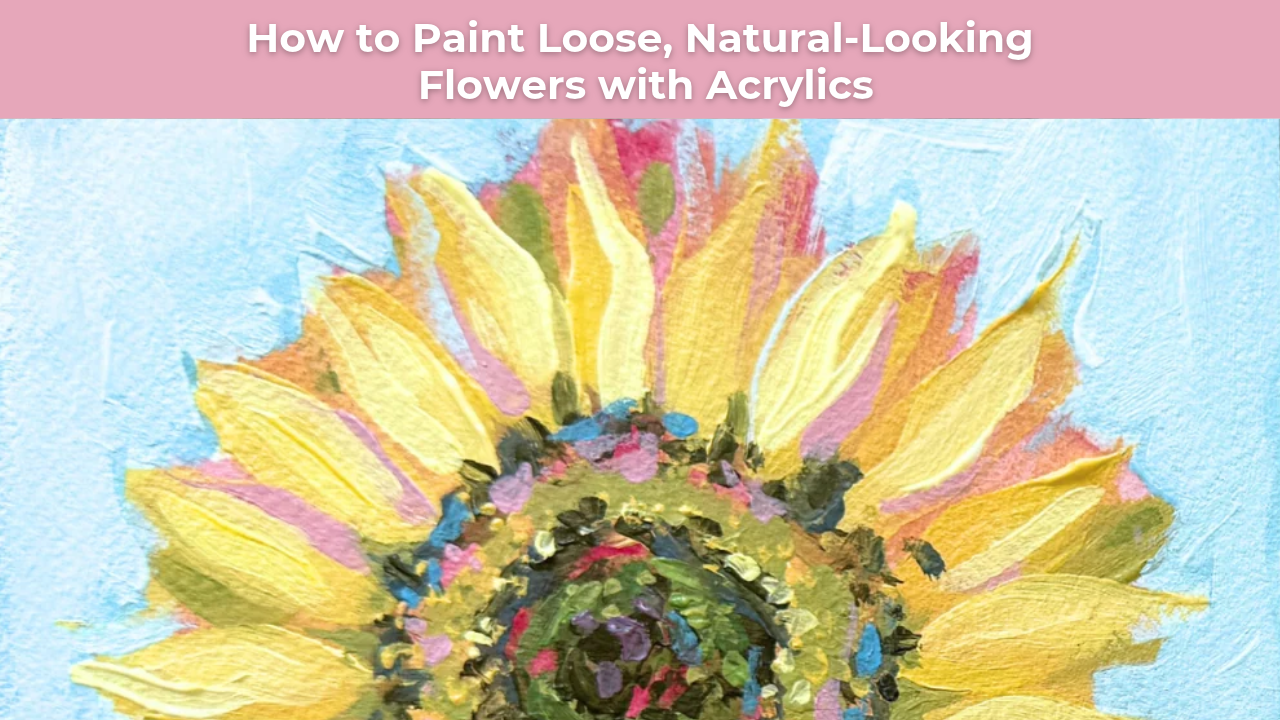
While painting our Sunflower Skill Builder inside Studio B Art Club, I intentionally avoided creating perfectly spaced petals.
Instead, I let some marks be jagged, allowed petals to overlap, and left certain areas feeling a little unexpected.
If you look closely at the finished painting, you'll notice several things.
Some petals are noticeably shorter than others.
A few overlap their neighbors.
And in certain areas, the edges of the petals become less defined, allowing them to blend into the surrounding colors.
None of these decisions were accidental.
They were intentional choices designed to make the flower feel more natural and expressive.
The goal isn't to paint every petal perfectly. It's to make the flower feel like a flower.
This is an important distinction because it shifts your focus away from reproducing individual details and toward capturing the overall character of your subject.
Five Ways to Paint More Natural-Looking Flower Petals
If your floral paintings tend to feel stiff or overly controlled, here are five techniques you can practice to introduce more movement and variety.
1. Vary the Shapes of Your Petals
Instead of painting every petal with the same shape, experiment with different lengths, widths, and angles.
Some petals might be long and narrow, while others are shorter or slightly curved.
You can even allow a few to bend in unexpected directions.
These variations help break up repetitive patterns and create a more organic appearance.
2. Let Your Petals Overlap
One of the easiest ways to create depth in a floral painting is to allow petals to overlap.
In nature, petals rarely sit neatly beside one another without interacting.
Some sit in front, while others are partially hidden behind them.
When you incorporate these relationships into your painting, you begin creating a stronger sense of dimension.
And remember, you don't need to carefully outline every overlapping petal.
Sometimes a small change in value or color is enough to suggest that one petal is sitting in front of another.
3. Change Your Brush Pressure
If every brushstroke is made with the same amount of pressure, your petals may begin to look too uniform.
Try varying the pressure as you move your brush across the canvas.
Press a little harder to create a wider mark, then lighten your pressure to create a narrower edge.
You can also change the direction of your brushstrokes to introduce more movement.
This is especially helpful when painting loose acrylic flowers because it allows your brushwork to become part of the character of the painting.
4. Allow Some Edges to Disappear
Not every petal needs a perfectly defined outline.
In fact, one of my favorite ways to create a more expressive painting is to allow certain edges to become less distinct.
Artists often refer to these as lost edges.
A lost edge occurs when the boundary between two shapes becomes difficult to distinguish, often because their colors or values are similar.
In my sunflower painting, I intentionally allowed some petal edges to blend into the surrounding colors.
This creates a beautiful contrast with the sharper, more defined edges elsewhere in the flower.
When every edge is equally sharp, everything competes for attention. But when some edges are lost and others are found, the painting begins to feel more natural.
5. Resist the Urge to Correct Every Brushstroke
This might be the hardest tip of all!
Sometimes we make a brushstroke that looks a little unexpected, and our first instinct is to immediately fix it.
Maybe a petal is slightly crooked.
Maybe the paint creates an irregular edge.
Or maybe two colors mix together in a way we hadn't planned.
Before correcting it, take a moment to step back.
Does that unexpected mark actually add something interesting to the painting?
You might be surprised how often those imperfect brushstrokes become your favorite parts.
Not every mark needs to be corrected, softened, or refined.
Sometimes the best artistic decision is simply to leave it alone.
How to Keep Your Floral Paintings Loose and Expressive
One of the things I encourage artists to practice is looking at their paintings as a whole rather than becoming overly focused on individual details.
When you're painting a sunflower, for example, it's easy to spend so much time perfecting each petal that you lose sight of the overall shape and movement of the flower.
Instead, try stepping back periodically and asking yourself:
-
Does the flower feel natural?
-
Is there enough variation in the shapes and directions of the petals?
-
Are some areas more defined than others?
-
Does the brushwork feel expressive, or am I trying to control every mark?
-
Could I simplify an area instead of adding more detail?
These questions help you evaluate the overall impression of your painting rather than judging the accuracy of every individual brushstroke.
And that's where some of the most exciting artistic growth happens.
The Beauty of Imperfect Brushstrokes
I think one of the most rewarding parts of painting is learning to appreciate the unexpected.
A brushstroke doesn't always land exactly where we intended.
A petal might turn out shorter than we planned.
Two colors might blend together in an interesting way.
And sometimes those little surprises are what make the painting feel alive.
A beautiful painting doesn't require perfect brushstrokes. It requires thoughtful decisions about which marks to make, which to change, and which to leave alone.
So the next time your floral painting starts feeling a little stiff, try introducing some imperfection.
Vary your shapes.
Change your brush pressure.
Let a few petals overlap.
And put down a brushstroke without immediately correcting it.
You might be surprised by how much more life it gives your painting.
Learn to Paint Expressive Flowers in Studio B Art Club
If you'd like to practice these techniques alongside me, my Sunflower Skill Builder is available inside Studio B Art Club.
In this acrylic painting lesson, we focus on creating natural-looking petals through expressive brushwork, overlapping shapes, and intentional variation.
Inside Art Club, you'll find a growing library of step-by-step acrylic painting tutorials and Skill Builders designed to help you practice techniques like these while developing your own artistic style.
Whether you're a beginner or an experienced painter looking to loosen up your work, I'd love to paint with you!
Want More Weekly Art Tips?
If you found this helpful, you’ll love our exclusive weekly art tips delivered straight to your inbox! Sign up below to get insights, painting techniques, and creative inspiration—plus first access to exciting opportunities inside Studio B.
We hate SPAM. We will never sell your information, for any reason.