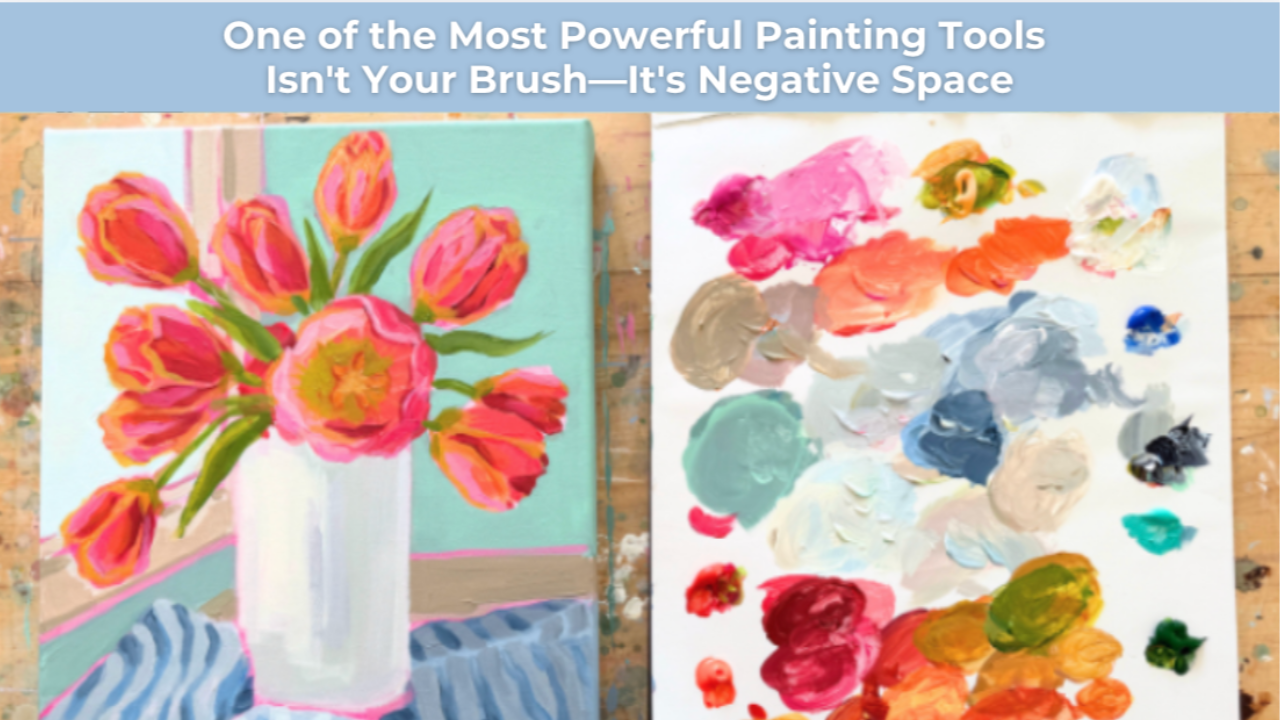
One of the Most Powerful Painting Tools Isn't Your Brush - It's Negative Space
When most artists think about improving a floral painting, they focus on the flower itself.
They study petals.
They add more highlights.
They refine every tiny detail.
But one of the biggest improvements you can make to your painting often has nothing to do with the flower at all.
It has everything to do with the negative space around it.
Learning to see and paint negative space can completely change the way you approach loose, expressive florals.
What Is Negative Space?
Negative space is simply the area around and between the subject you're painting.
If you're painting a delphinium, the flowers and stems are the positive shapes.
The background surrounding them is the negative space.
Most beginners treat the background as something to fill in after the painting is finished.
But experienced painters often think about it very differently.
The background isn't just a background.
It's an editing tool.
Paint the Background Last
One technique I use often when painting loose florals is intentionally leaving the background until the end.
Rather than trying to perfectly define every petal from the beginning, I allow myself to paint freely and focus on establishing the overall form of the flower first.
Once that's in place, I paint the background around the subject.
This gives me the opportunity to carve back into the painting using the background color itself.
Instead of adding more paint to fix mistakes, I'm refining the shapes by subtracting.
It's a small shift in process, but it makes a huge difference.
Why Negative Space Matters
Painting the negative space allows you to refine your subject in ways that can be difficult to achieve by painting directly on the flower.
It helps you:
- Separate overlapping petals.
- Create cleaner, more elegant edges.
- Refine thin stems and delicate shapes.
- Add movement and breathing room throughout the composition.
Sometimes the most beautiful lines in a painting aren't created by the object itself.
They're created by what's painted around it.
Sometimes Less Paint Creates Better Results
One of the biggest breakthroughs artists experience is realizing that not every improvement comes from adding another brushstroke.
Sometimes the answer is actually to remove visual clutter.
Painting the background around a flower often softens edges naturally, clarifies shapes, and gives the subject more room to breathe.
Instead of feeling overworked, the painting begins to feel intentional.
Expressive.
Balanced.
It's a reminder that good painting isn't always about adding more.
Sometimes it's about revealing what's already there.
You Don't Have to Solve Everything on the First Pass
Many artists feel pressure to get every petal exactly right the first time they paint it.
But paintings rarely come together in one perfect layer.
They evolve.
Each layer gives you new information.
Each pass allows you to make better decisions.
When you know you can return later with the background color to refine edges and reshape forms, there's much less pressure to make every brushstroke perfect from the start.
That freedom often leads to looser, more confident paintings.
Learn to Paint in Layers
One of the biggest mindset shifts in painting is understanding that clarity often comes from refinement—not perfection.
Your first layer doesn't have to do everything.
It simply needs to give you something to respond to.
As the painting develops, you can use the negative space to sharpen one edge, soften another, separate petals, simplify shapes, or guide the viewer's eye through the composition.
That's where so much of the magic happens.
The next time you're painting flowers, don't think of the background as the final step you have to get through.
Think of it as one of the most powerful tools you have.
Because sometimes the most beautiful shapes in a painting aren't painted directly.
They're revealed by carefully painting everything around them.
Grow Your Confidence by Seeing Paintings Differently
Inside Studio B Art Club, we spend a lot of time learning techniques like this that make painting feel more intuitive. Through step-by-step tutorials and foundational lessons, you'll learn how to see beyond the obvious—using concepts like negative space, value, and simplification to create paintings that feel loose, expressive, and full of life.
Because becoming a stronger artist isn't just about learning what to paint.
It's about learning how to see. 🎨
Want More Weekly Art Tips?
If you found this helpful, you’ll love our exclusive weekly art tips delivered straight to your inbox! Sign up below to get insights, painting techniques, and creative inspiration—plus first access to exciting opportunities inside Studio B.
We hate SPAM. We will never sell your information, for any reason.