Stop Painting Every Flower First: Simplify Your Bouquet Before You Add the Details
One of the biggest mistakes I see artists make when painting florals is trying to paint every single flower immediately.
Every petal.
Every fold.
Every tiny detail.
It feels productive in the moment, but it's often the exact point where a painting starts to feel overwhelming.
Instead of creating a cohesive arrangement, you're trying to solve dozens of small problems all at once. Before long, it's easy to lose sight of the overall composition.
The solution isn't better brushwork.
It's a better starting point.
See the Bouquet Before the Flowers
When you first look at a bouquet, your brain naturally notices the individual blooms.
But as artists, we have to train ourselves to see something different.
Before painting a single flower, ask yourself:
What is the overall shape of this arrangement?
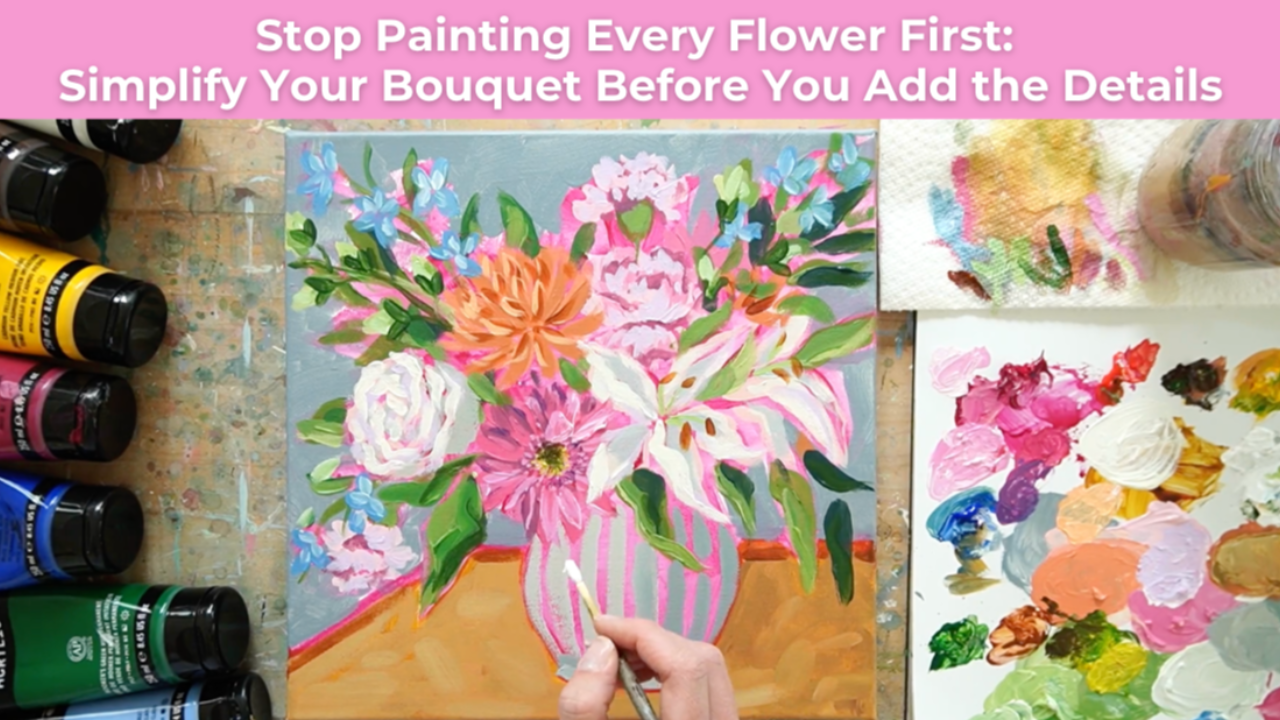
Think of the bouquet as one large silhouette instead of twenty separate flowers.
The vase becomes one simple mass.
The flowers become one connected form.
When you simplify the arrangement into larger shapes first, you're building a strong foundation that every detail can sit on later.
Ask Better Questions
Instead of asking:
"What does every flower look like?"
Try asking:
"Where does the bouquet live on the canvas?"
That subtle shift changes the way you approach the entire painting.
Now you're thinking about composition before detail.
Structure before decoration.
The painting immediately feels less overwhelming because you're solving the biggest problems first.
Focus on What Actually Makes a Bouquet Feel Beautiful
A successful floral painting isn't simply a collection of well-painted flowers.
It's an arrangement that feels balanced, intentional, and full of movement.
As you block in your larger shapes, pay attention to:
- Movement throughout the arrangement.
- Balance between large and small forms.
- Flow that guides the viewer's eye across the painting.
These are the qualities that give a bouquet life long before you've painted a single detailed petal.
Don't Forget the Outline
One of my favorite parts of painting florals is studying the silhouette before I ever think about what's happening inside it.
The outline tells you so much about the arrangement.
Ask yourself:
- Does the bouquet feel loose and airy or full and gathered?
- Where are the largest masses of flowers?
- How does the negative space around the bouquet create movement?
- Is the overall shape interesting from a distance?
If the silhouette is working, the painting already has a strong foundation.
The individual flowers simply become supporting characters.
The Reference Photo Isn't a Rulebook
Another common mistake is trying to copy every flower exactly as it appears in your reference.
But a reference photo is exactly that—a reference.
Not a blueprint.
Not a checklist.
You don't need to include every bloom.
You don't need to recreate every leaf.
In fact, simplifying often leads to a stronger painting.
As you work, give yourself permission to move flowers, combine shapes, remove distractions, or exaggerate movement if it serves the composition.
Your goal isn't to duplicate the reference.
Your goal is to create a beautiful painting.
Expressive Paintings Start with Simplicity
One of the biggest breakthroughs an artist can have is realizing that expressive painting isn't about adding more detail.
It's about learning to simplify.
When you begin seeing bouquets as collections of larger shapes instead of hundreds of individual petals, painting becomes more intuitive.
Less overwhelming.
More enjoyable.
And surprisingly, your finished paintings often feel more alive because they aren't buried beneath unnecessary detail.
The next time you paint a floral arrangement, resist the urge to start with the flowers.
Start with the bouquet.
Build the larger shapes.
Then let the details grow naturally from there.
You may discover that simplifying is the very thing that brings your paintings to life.
Learn to Simplify with Confidence
Inside Studio B Art Club, we spend a lot of time learning how to simplify complex subjects into manageable shapes. Through step-by-step tutorials, skill builders, and foundational lessons, you'll learn to see the big picture first—so every painting feels more intuitive and less overwhelming.
Because expressive painting isn't about painting more.
It's about learning to see differently. 🎨
Want More Weekly Art Tips?
If you found this helpful, you’ll love our exclusive weekly art tips delivered straight to your inbox! Sign up below to get insights, painting techniques, and creative inspiration—plus first access to exciting opportunities inside Studio B.
We hate SPAM. We will never sell your information, for any reason.