The Beauty of Leaving Things Unfinished
Have you ever finished a painting and thought…
“Something about this just feels… still.”
That feeling can be frustrating, especially after carefully choosing your colors, refining your drawing, and spending time getting all the details just right.
But often, it's not about incorrect colors or proportions.
It's because everything is being treated the same way.
Every edge is outlined. Every highlight is pushed equally bright. Every shadow sits at a similar value. Every brushstroke carries the same visual weight.
And when everything is emphasized, nothing stands out.
There's no place for the eye to rest and no clear sense of what matters most.
The good news? Sometimes the solution isn't adding more to your painting. It's knowing when to stop.
Why Contrast and Variety Matter in Painting
One of the most important things I've learned as an artist is that a painting needs variety to feel alive.
Think about how your eye moves through a painting.
When every edge is sharp, every color is equally saturated, and every detail is carefully defined, your eye doesn't know where to focus.
Everything is competing for attention.
But when some areas are crisp and others are soft, when certain colors are vibrant and others are quiet, and when some details are defined while others are left unfinished, something interesting happens.
Your eye begins to move through the painting naturally.
You create a visual hierarchy that helps guide the viewer toward the most important parts of your composition.
This is one of the reasons I love working with expressive brushwork and allowing earlier layers of paint to remain visible.
Not everything needs to be perfectly refined to be beautiful.
In fact, those imperfect, unexpected areas often become my favorite parts of a painting.
Learning When to Soften an Edge
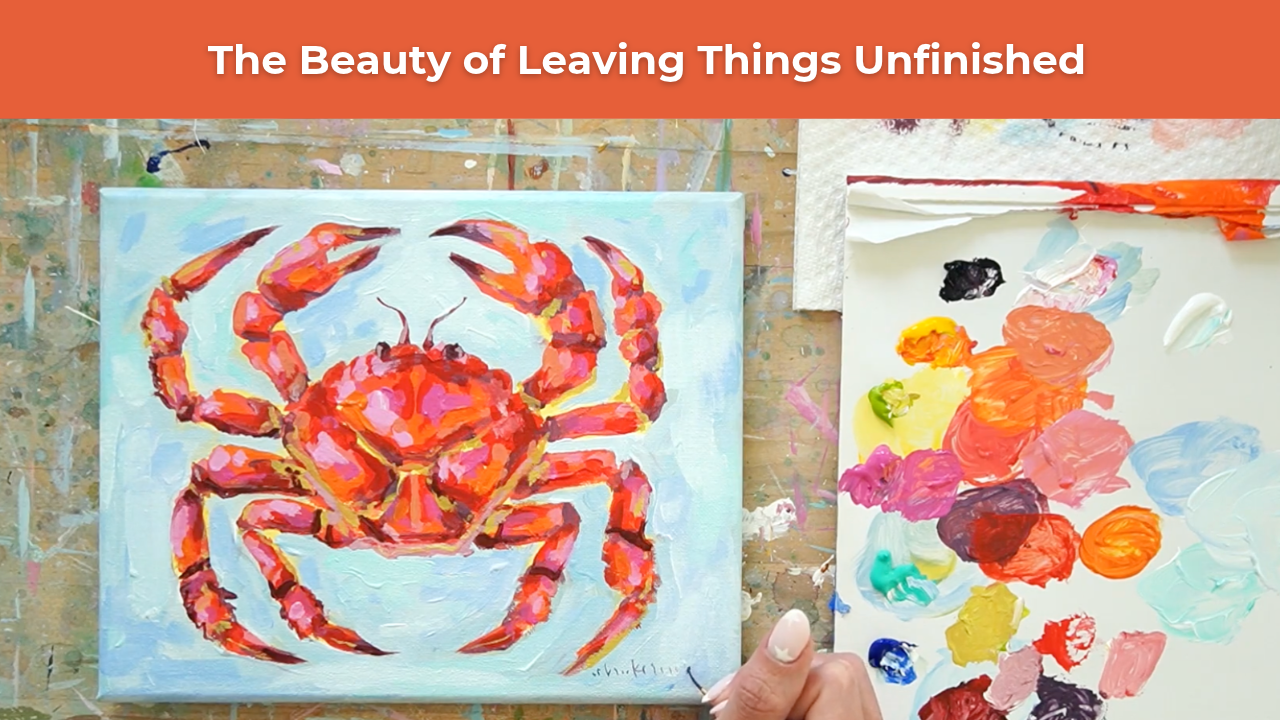
While painting my Summer Crab tutorial for Studio B Art Club, I focused on avoiding that overly controlled, predictable look.
I wanted the painting to feel loose, colorful, and full of movement.
Throughout the painting process, I kept asking myself a few questions:
-
Does this edge need to be sharp, or could it be softened?
-
Should I let some of that earlier yellow layer show through?
-
Would another dark line strengthen this area, or just clutter it?
-
Does this area really need another highlight?
These might seem like small decisions, but collectively, they make an enormous difference.
For example, if every edge of the crab were outlined with the same level of definition, the painting would begin to feel stiff.
Instead, I allowed some edges to remain loose and undefined while emphasizing others.
Those sharper edges help establish the form, while the softer areas give the painting room to breathe.
This balance between sharp and soft edges is one of the simplest ways to create a more expressive painting.
The Beauty of Letting Earlier Layers Show Through
Another way I create variety in my paintings is by allowing earlier layers of color to remain visible.
When I'm working on a painting, I don't necessarily want to cover every inch of the canvas with perfectly blended, finished color.
Sometimes those little glimpses of the underpainting are exactly what the composition needs.
In my Summer Crab painting, I intentionally allowed areas of the earlier yellow layer to peek through.
Those unexpected touches of color add warmth, energy, and visual interest.
They also create a beautiful contrast with the more developed areas of the painting.
This is something I encourage artists to experiment with, especially if they tend to overwork their paintings.
You don't have to cover every brushstroke from the previous layer.
Sometimes leaving it alone is the better artistic decision.
Sometimes the Best Decision Is to Stop Painting
I think one of the hardest skills to develop as an artist is knowing when to stop.
It's tempting to keep adding details, refining edges, and adjusting colors until everything feels completely finished.
But sometimes, the more we work on a painting, the more we lose the qualities that made it interesting in the first place.
We smooth away the expressive brushstrokes.
We cover up the unexpected colors.
We define every edge.
And before we know it, we've removed much of the movement and energy from the painting.
Sometimes the best choice isn't adding more. It's stopping.
Letting a passage stay simple.
Allowing earlier layers to remain visible.
Giving your eyes somewhere to rest.
Those moments of restraint often become the most beautiful parts of a painting.
How to Create More Movement and Energy in Your Paintings
The next time you sit down to paint, I want you to try something a little different.
Instead of focusing entirely on getting every detail right, pay attention to the variety you're creating throughout the composition.
Here are a few things to practice:
1. Leave Some Areas Intentionally Unfinished
Not every part of your painting needs the same amount of attention.
Allow some areas to remain loose and suggestive while developing others more fully.
2. Let Earlier Layers Peek Through
Resist the urge to cover every bit of your underpainting.
Those unexpected colors can create beautiful relationships and add depth to your work.
3. Vary Your Edges
Create a balance between crisp, defined edges and softer, less distinct areas.
This helps direct the viewer's eye and keeps your painting from feeling overly controlled.
4. Resist Outlining Every Shape
Before adding another dark line, ask yourself whether it strengthens the composition or simply adds unnecessary detail.
Sometimes a change in color or value is enough to suggest the form.
5. Give Your Painting Room to Breathe
Step back frequently and evaluate your painting as a whole.
Look for areas that feel too busy or overly developed.
Remember that quiet areas are just as important as the areas that demand attention.
Give Your Painting Room to Breathe
One of the things I love most about painting is that there's always something new to discover.
Even after years of painting, I still find myself learning when to push an area further and when to leave it alone.
And I think you'll be surprised how much more natural, relaxed, and engaging your work feels when you begin embracing that balance.
The next time your painting feels flat or overly controlled, don't immediately reach for another color or add another detail.
Instead, ask yourself:
Where could I create more variety? And where could I simply stop?
Sometimes, that's exactly what your painting needs.
Paint With Me in Studio B Art Club
If you'd like to see these techniques in action, my Summer Crab acrylic painting tutorial is available inside Studio B Art Club!
Throughout the lesson, I walk you through my painting process, sharing how I approach color, simplify shapes, build layers, and make creative decisions along the way.
And the best part? These are skills you can carry into every painting you create, regardless of the subject.
Inside Studio B Art Club, you'll find a growing library of step-by-step acrylic painting tutorials designed to help you build confidence, develop your artistic eye, and create paintings that feel uniquely your own.
Want More Weekly Art Tips?
If you found this helpful, you’ll love our exclusive weekly art tips delivered straight to your inbox! Sign up below to get insights, painting techniques, and creative inspiration—plus first access to exciting opportunities inside Studio B.
We hate SPAM. We will never sell your information, for any reason.