The Secret to Painting Better Flowers: Start with Values, Not Petals
One of the biggest mistakes I see artists make when painting florals has nothing to do with color.
It has to do with timing.
As soon as the outline of a flower is on the canvas, it's tempting to jump straight into painting individual petals. After all, that's the fun part.
But here's the problem:
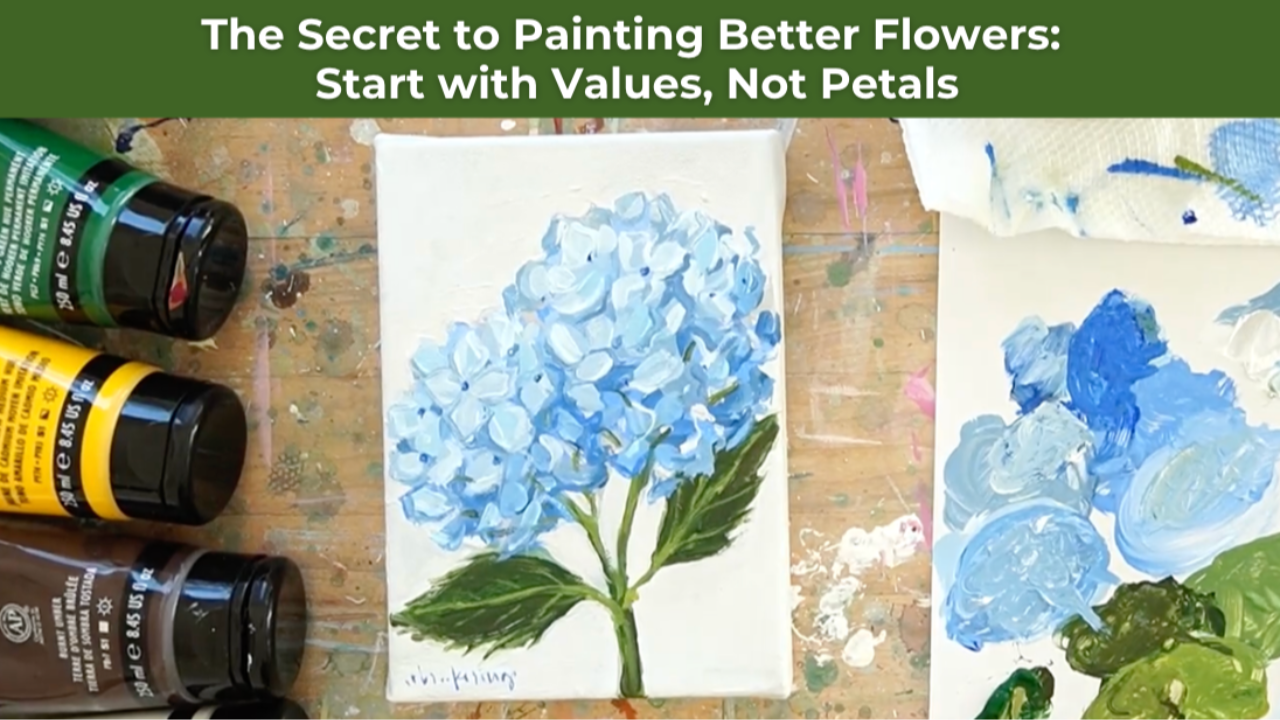
A hydrangea isn't made up of dozens of perfect little flowers. It's made up of one large form that's broken into smaller shapes. When you focus on the petals too early, it's easy to lose sight of the overall structure. The painting starts to feel busy without ever gaining real depth.
Instead of thinking about petals first, think about values first.
Why Values Matter More Than Details
Before worrying about every petal, ask yourself a simple question:
Where are my lightest lights? Where are my darkest darks? And what lives in between?
Those three value groups are what create the illusion of form.
When your values are accurate, even a loosely painted flower can look dimensional and believable. Without them, adding more details usually doesn't improve the painting—it just makes it more complicated.
Many artists assume they need more detail when what they really need is stronger value contrast.
The MAP Method
One of the simplest ways to approach floral painting is to build the painting in layers rather than trying to finish every section all at once.
I like to follow what I call the MAP Method:
M — Midtones First
Start by blocking in the largest shapes using your middle values.
Don't worry about individual petals yet. Instead, establish the overall form and silhouette of the flower.
A — Add Lights and Darks
Once the foundation is in place, begin introducing your shadows and highlights.
This is where the flower starts to come to life. The value shifts create depth and help separate the different planes of the bloom.
P — Polish with Details Last
Only after the values feel solid should you begin refining edges or suggesting individual petals.
At this stage, the details become the finishing touch—not the foundation of the painting.
Why This Approach Works
When you build the structure first, every brushstroke has a purpose.
Instead of chasing tiny details, you're creating a strong painting from the inside out.
You'll often find that you need far fewer petals than you originally thought because the eye naturally fills in what's implied.
That's one of the beautiful things about expressive painting: you don't have to paint every single detail to create something that feels complete.
A Simple Habit That Will Improve Every Floral Painting
The next time you're painting flowers, pause before reaching for your detail brush.
Ask yourself:
Do I actually need more detail... or do I need stronger lights and darks?
That one question can completely change the direction of a painting.
More often than not, strengthening your values will create far more impact than adding another layer of petals.
Master the big shapes first.
Then let the details simply support the work you've already done.
Want to Build Stronger Paintings from the Ground Up?
Inside Studio B Art Club, we don't just paint step-by-step tutorials—we learn why each brushstroke matters.
Every lesson is designed to help you understand composition, color, values, and technique so you can confidently paint your own artwork, not just copy a reference photo.
If you're ready to simplify the painting process and build skills that carry into every piece you create, we'd love to have you join us. 🎨
Want More Weekly Art Tips?
If you found this helpful, you’ll love our exclusive weekly art tips delivered straight to your inbox! Sign up below to get insights, painting techniques, and creative inspiration—plus first access to exciting opportunities inside Studio B.
We hate SPAM. We will never sell your information, for any reason.