What Does Your Painting Need? Learning to Trust Your Artistic Eye
One of the biggest shifts I've experienced as an artist happened when I stopped trying to perfectly recreate my reference photo and started asking a much more important question:
What does my painting need?
It sounds simple, but learning to make decisions based on the painting in front of you, rather than the photograph you're working from, can completely change the way you approach your artwork.
It's also one of the most important steps in developing your own artistic style.
Your Reference Photo Is a Starting Point, Not a Rulebook
When I begin a painting, my reference photo plays an important role.
I'm studying the composition, simplifying shapes, establishing values, and thinking through how I want to approach the subject. All of these decisions help me build a strong foundation before I get too far into the painting process.
But at some point, my focus shifts.
Instead of asking, "What does the reference photo look like?" I start asking, "What does my painting need?"
And that's where things start to get interesting.
A reference photo can tell you what something looks like, but it can't always tell you what will make a beautiful painting.
Sometimes the colors need to change. Sometimes an area needs to be simplified. Sometimes a shape needs to be exaggerated or a distracting detail needs to disappear altogether.
The goal isn't necessarily to recreate the photograph. It's to use the photograph as a starting point for creating something entirely your own.
Learning to See Your Painting as a Whole
One of the habits I encourage my Studio B Art Club members to practice is stepping back from their paintings throughout the creative process.
When we're working up close, it's easy to become so focused on individual petals, leaves, or brushstrokes that we lose sight of the composition as a whole.
But a successful painting isn't simply a collection of perfectly rendered details. It's a relationship between shapes, colors, values, and the way our eyes move through the artwork.
Stepping back gives us the opportunity to evaluate those relationships.
Here are five questions I like to ask myself throughout the painting process:
-
Where does my eye go first? Is that where I want the viewer's attention to go?
-
Does anything feel too heavy or distracting? Are certain colors, shapes, or details competing for attention?
-
Could another highlight strengthen the focal point? Would a small adjustment in value help direct the viewer's eye?
-
Is there an area I could simplify? Would removing a few details make the composition stronger?
-
Does the painting feel balanced? Are the colors, shapes, and visual weight working together?
These questions will take you much further than constantly checking whether every detail matches your reference photo.
Making Changes That Serve the Painting
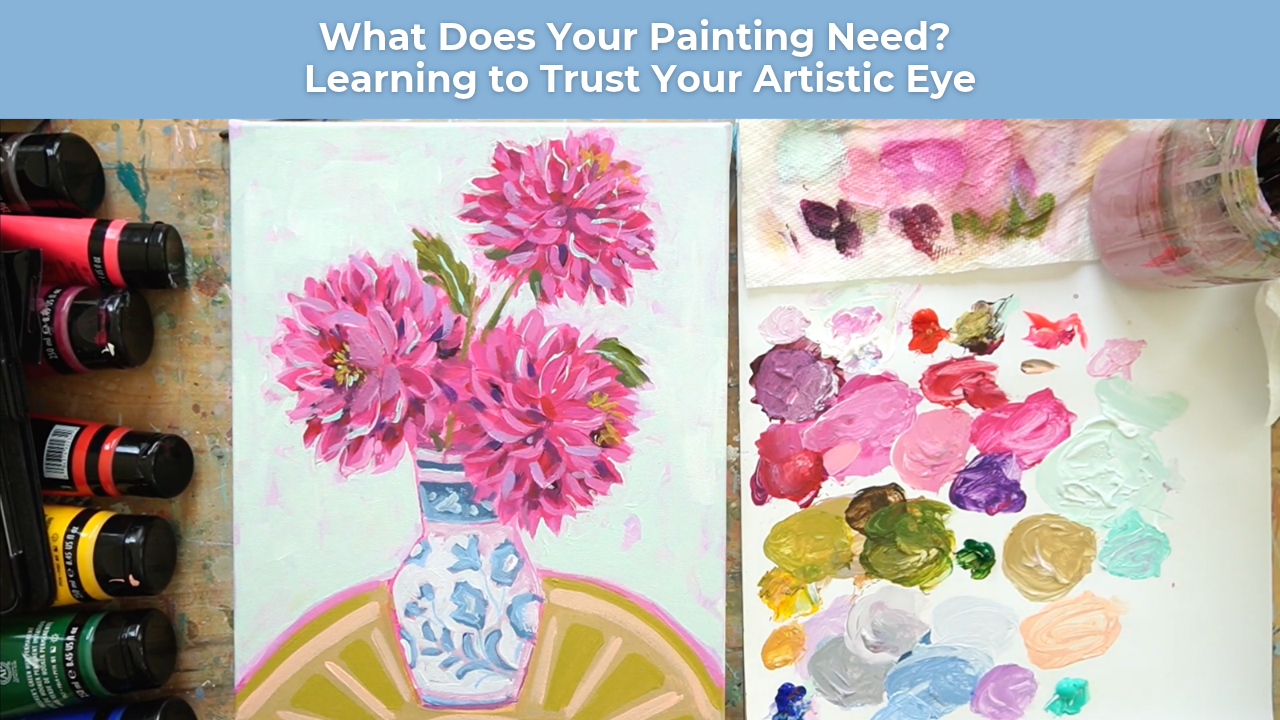
While filming my Summer Dahlias tutorial for Studio B Art Club, I found myself making several changes that weren't present in my original reference photo.
As the painting developed, I realized certain areas needed to be adjusted to create a stronger composition.
I simplified some of the shapes, made subtle changes to the background color, and adjusted details on the table.
None of these decisions were about making the painting more accurate to the photograph.
They were about making the painting better.
This is something I want artists to understand: you have permission to change what you see.
You can move a flower, adjust a color, simplify a background, or leave something out entirely.
In fact, those decisions are often what make your artwork interesting.
This Is Where Your Artistic Voice Begins to Emerge
Developing your own artistic style isn't necessarily about finding a completely new way to paint.
Often, it's about learning to recognize the decisions you're naturally drawn to making.
Maybe you love exaggerating color. Maybe you prefer simplified shapes and loose brushwork. Maybe you're drawn to bold compositions or unexpected color combinations.
As you begin making more intentional decisions about what your painting needs, those preferences start showing up in your work.
And over time, they become part of your artistic voice.
This is why I believe learning to paint is about so much more than learning how to accurately represent a subject.
It's about developing the confidence to make your own creative decisions.
Learning to Trust Your Artistic Eye
Learning to listen to your painting is one of the most rewarding skills you can develop as an artist.
It takes practice, and it requires a willingness to step away from the idea that there's only one correct way to interpret your reference.
But the more you practice evaluating your work, the more confident you'll become in recognizing what needs to change.
You'll begin to see opportunities to simplify, strengthen, and bring your own perspective into a painting.
And eventually, you'll find yourself spending less time worrying about whether your painting looks exactly like the photograph and more time thinking about whether it communicates what you want it to.
So the next time you paint, leave yourself with one simple question:
What does my painting need?
Some of the best decisions you'll make as an artist won't come from your reference photo. They'll come from learning to trust your own eye.
Learn to Paint with Confidence in Studio B Art Club
If you're ready to move beyond simply copying reference photos and start creating paintings that feel uniquely your own, I'd love to welcome you to Studio B Art Club.
Inside the membership, I teach you how to approach a painting from the very beginning, breaking down subjects into manageable shapes, understanding color and composition, and making creative decisions with confidence.
Through step-by-step acrylic painting tutorials, you'll learn not just how to paint a particular subject, but how to develop the skills to approach new subjects on your own.
Want More Weekly Art Tips?
If you found this helpful, you’ll love our exclusive weekly art tips delivered straight to your inbox! Sign up below to get insights, painting techniques, and creative inspiration—plus first access to exciting opportunities inside Studio B.
We hate SPAM. We will never sell your information, for any reason.