
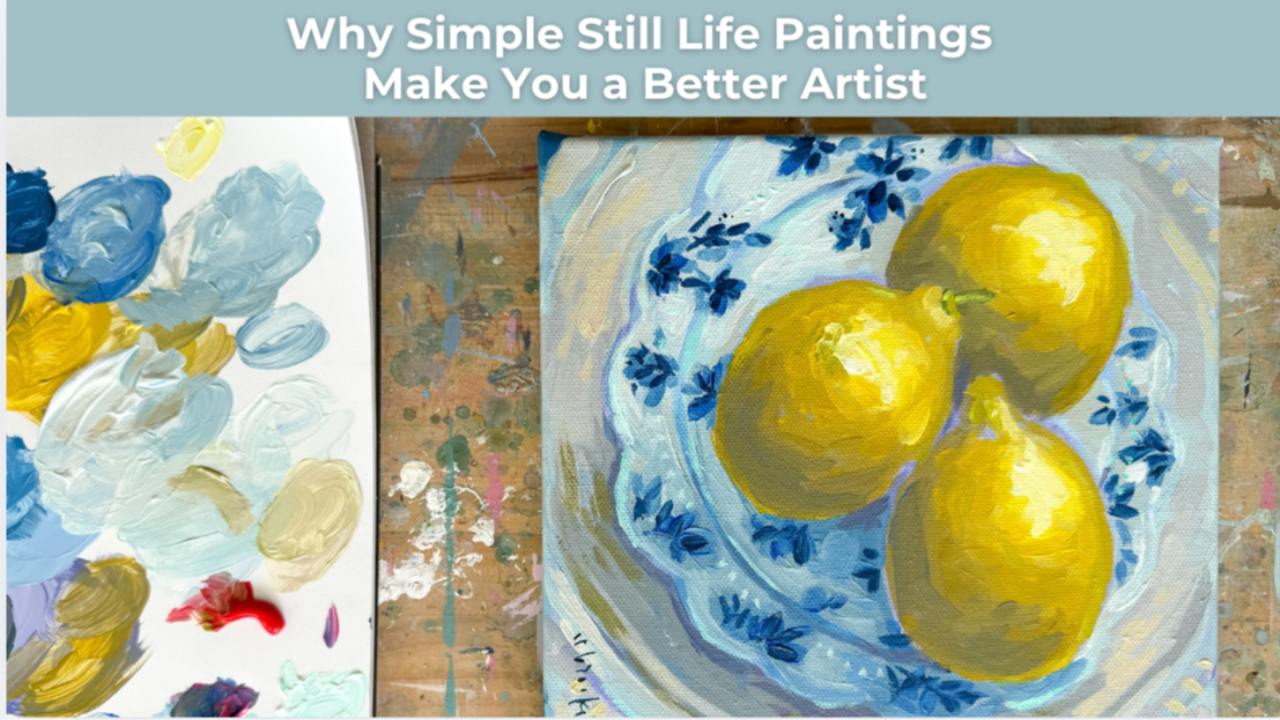
Why Simple Still Life Paintings Make You a Better Artist
When most artists think about improving their painting skills, they assume they need to tackle more challenging subjects.
More complicated florals.
More detailed landscapes.
More intricate compositions.
But sometimes, the fastest way to grow is to simplify.
That's exactly why I love painting still lifes.
At first glance, a bowl of lemons might seem like a simple subject. But once you slow down and really observe what's in front of you, you realize it's teaching some of the most important fundamentals in painting.
Simplicity Helps You See More Clearly
When a subject isn't competing for your attention with hundreds of tiny details, you begin noticing something much more important:
Light.
Shadow.
Form.
Instead of asking, How do I paint this lemon? you begin asking better questions:
- Where is the light strongest?
- Where does the form begin to turn away from the light?
- Which edges are soft, and which are sharp?
These observations are what create believable, three-dimensional paintings.
The lemon simply becomes the vehicle for learning them.
See the Shape Before the Details
One of the biggest mistakes beginners make is jumping straight into details.
They start painting tiny highlights, textured peel, or subtle color shifts before they've established the overall form.
But every object—even something as organic as a lemon—is first just a simple shape.
When you train yourself to see the larger form before the smaller details, painting becomes much more manageable.
Instead of trying to solve fifty little problems, you're solving one important one first.
Once the structure is right, the details naturally fall into place.
Value Creates Dimension
Color often gets all the attention, but value is what gives a painting its depth.
Before worrying about finding the perfect shade of yellow, ask yourself:
- Which areas are catching the most light?
- Where are the darkest shadows?
- What are the midtones connecting those two extremes?
These value relationships are what transform a flat circle into a believable lemon.
Without strong values, even the most accurate colors can feel lifeless.
Color Is More Than "Yellow"
One of my favorite lessons from painting lemons is realizing that very little of the fruit is actually one flat yellow.
Depending on the light, you'll often see:
- Cool blues reflected from nearby objects.
- Warm oranges bouncing into the shadows.
- Soft greens where surrounding colors influence the surface.
- Creamy whites in the brightest highlights.
Learning to paint what you actually see—not what you assume is there—is one of the biggest breakthroughs an artist can experience.
Slow Down and Observe
Painting isn't always about adding more.
Sometimes it's about seeing more.
When you slow down enough to observe carefully, you begin noticing relationships you may have overlooked before.
The subtle curve of a shadow.
The way reflected light softens one edge.
The slight temperature shift between light and shadow.
Those small observations are what separate a thoughtful painting from one that feels rushed.
Strong Foundations Lead to Better Paintings
It's easy to chase new techniques, trendy styles, or more complicated subjects.
But the artists who continue to improve are usually the ones who return to the fundamentals again and again.
Simplification.
Structure.
Value.
Intentional brushwork.
These skills don't just help you paint a bowl of lemons—they help you paint anything with greater confidence.
The next time you sit down to paint, challenge yourself to slow down.
Observe a little longer.
Simplify a little more.
Look for the light before you look for the details.
You might be surprised by how much stronger your paintings become.
Build Your Foundations with Confidence
Inside Studio B Art Club, we regularly practice these foundational skills through step-by-step tutorials, skill builders, and lessons designed to strengthen the way you see as an artist.
Because the goal isn't simply to finish another painting.
It's to become the kind of artist who understands why a painting works—and can apply those principles to every canvas you create. 🎨
Want More Weekly Art Tips?
If you found this helpful, you’ll love our exclusive weekly art tips delivered straight to your inbox! Sign up below to get insights, painting techniques, and creative inspiration—plus first access to exciting opportunities inside Studio B.
We hate SPAM. We will never sell your information, for any reason.