Why Your Flower Paintings Feel Off (Hint: It's Not Your Brushwork)
Have you ever sat down to paint a flower and thought:
"Why does this feel so difficult?"
If so, you're not alone.
Many artists assume the problem is their brushwork or their ability to paint realistic petals. But more often than not, the issue starts much earlier in the process.
It starts with where you're placing your focus.
Most beginners begin by painting petals.
Instead, they should be starting with shape.
That one shift can completely change the way your paintings come together.
See the Flower as One Shape First
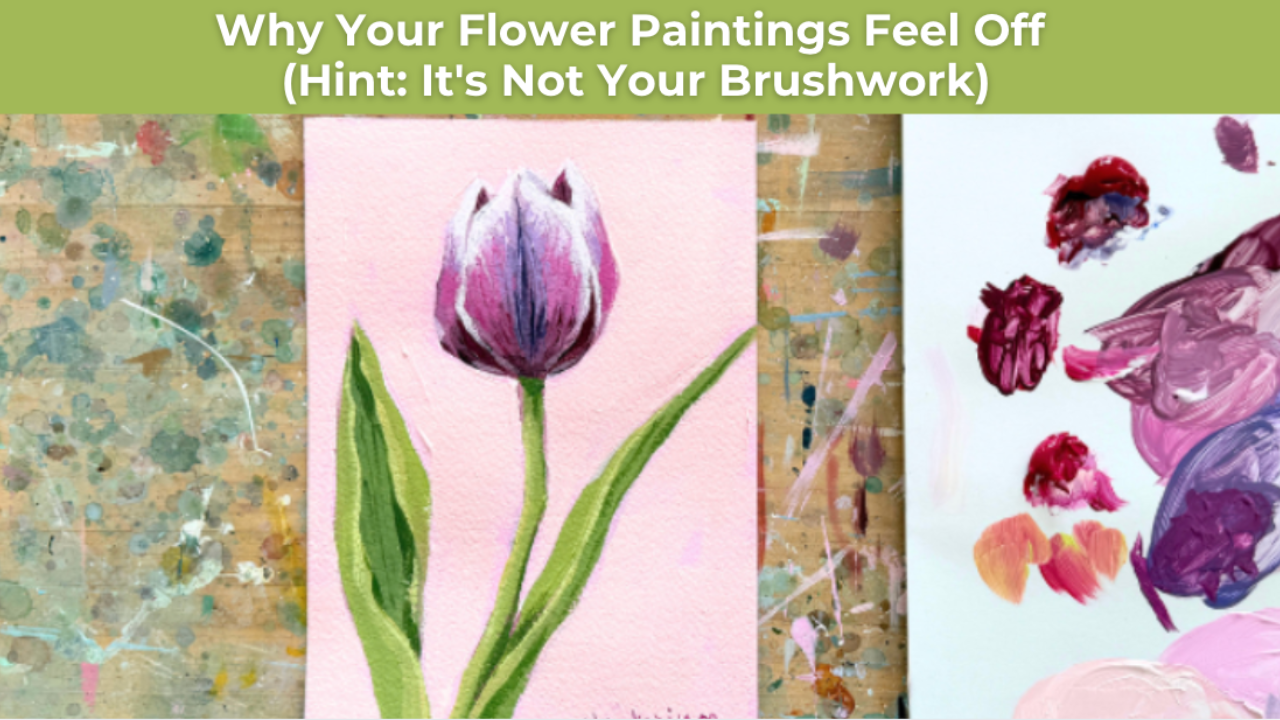
When we look at a tulip, our brains immediately notice the petals.
But when artists paint what they know instead of what they see, they often end up outlining each petal individually before establishing the overall form.
The result?
A painting that feels stiff, overworked, and difficult to correct.
Instead, try looking at the flower as one simple shape first.
A tulip, for example, can be simplified into something very close to a teardrop.
That larger shape becomes the foundation for everything that follows.
Why Starting with Shape Works
When you establish the overall form before worrying about details, several things happen naturally.
Your Painting Feels More Grounded
Beginning with a large, simple shape gives the painting structure from the very first brushstroke.
Instead of building dozens of tiny pieces that may or may not fit together, you're creating a solid foundation that supports the rest of the painting.
Your Proportions Improve
It's much easier to judge height, width, and placement when you're looking at one large shape instead of twenty small ones.
Because you've established the overall silhouette first, the smaller details naturally fall into place.
You Stop Guessing
One of the biggest causes of frustration in painting is constantly correcting proportions after you've already added details.
When you start with shape, those decisions happen early.
You're no longer guessing where each petal belongs.
You're building on a clear structure.
A Simple Three-Step Exercise
The next time you paint a flower, try this approach instead.
Step 1: Ask Yourself One Question
Before your brush touches the canvas, pause and ask:
What is the simplest shape I'm looking at?
Ignore the petals for a moment.
Look only at the overall silhouette.
Step 2: Block It In Loosely
Paint that simple shape without worrying about perfection.
Don't overthink it.
At this stage, you're simply creating a roadmap.
Step 3: Build from There
Once the larger form feels right, begin carving into it with smaller shapes.
Now the petals have somewhere to belong.
Instead of creating chaos, each brushstroke strengthens the structure you've already established.
Don't Aim for Perfect
One of the biggest mindset shifts that helped me grow as an artist was letting go of the idea that my first marks needed to be perfect.
They don't.
The first layer isn't meant to be beautiful.
It's meant to be useful.
I'm not trying to capture every petal right away.
I'm trying to capture the movement, proportion, and overall structure of the flower.
Once those things are in place, the details become much easier—and much more enjoyable—to paint.
Learn to See Before You Paint
Painting isn't just about learning how to move a brush.
It's about learning how to see.
When you begin recognizing the simple shapes hidden inside complex subjects, everything starts to feel more manageable.
Flowers become collections of forms instead of hundreds of tiny petals.
Painting becomes less overwhelming.
And your confidence begins to grow with every canvas.
The next time you sit down to paint a flower, resist the urge to start with the details.
Start with the shape.
You may be surprised by how much easier the rest of the painting becomes.
Build Strong Foundations with Every Painting
Inside Studio B Art Club, we focus on more than just finishing beautiful paintings—we teach you how to see like an artist.
Through full-length tutorials, skill builders, and foundational lessons, you'll learn how to simplify complex subjects, strengthen your compositions, and paint with greater confidence.
Because once you understand the structure behind what you're painting, everything starts to click. 🎨
Want More Weekly Art Tips?
If you found this helpful, you’ll love our exclusive weekly art tips delivered straight to your inbox! Sign up below to get insights, painting techniques, and creative inspiration—plus first access to exciting opportunities inside Studio B.
We hate SPAM. We will never sell your information, for any reason.