You Don't Have to Love Every Brushstroke: Learning to Paint with Confidence
One of the most freeing lessons you can learn as an artist is this:
You don't have to love every brushstroke you make.
When you're learning to paint, it's easy to believe that good painters simply make better marks.
They choose the right color.
Their brush lands in the right place.
And somehow, the painting just... works.
But that's not really how painting happens.
Even after years of painting, I still make brushstrokes that don't turn out the way I imagined. I choose colors that don't work, paint shapes that need adjusting, and occasionally cover entire sections of a painting because I've decided to take things in a different direction.
And that's completely normal.
The skill isn't making every brushstroke perfectly. It's learning to recognize what isn't working and knowing what to try next.
Why Every Brushstroke Doesn't Have to Be Perfect
One of the biggest misconceptions about painting is that experienced artists rarely make mistakes.
When you watch a finished painting come together in a short video, it can look almost effortless.
A few brushstrokes here, a little color there, and suddenly there's a beautiful painting.
But what you don't always see are the adjustments happening along the way.
The colors that get changed.
The shapes that get simplified.
The areas that get painted over.
Those decisions are just as important as the brushstrokes that remain visible in the finished piece.
And learning to make those decisions is a huge part of becoming a more confident artist.
What My Wildflower Meadow Painting Taught Me About Brushwork
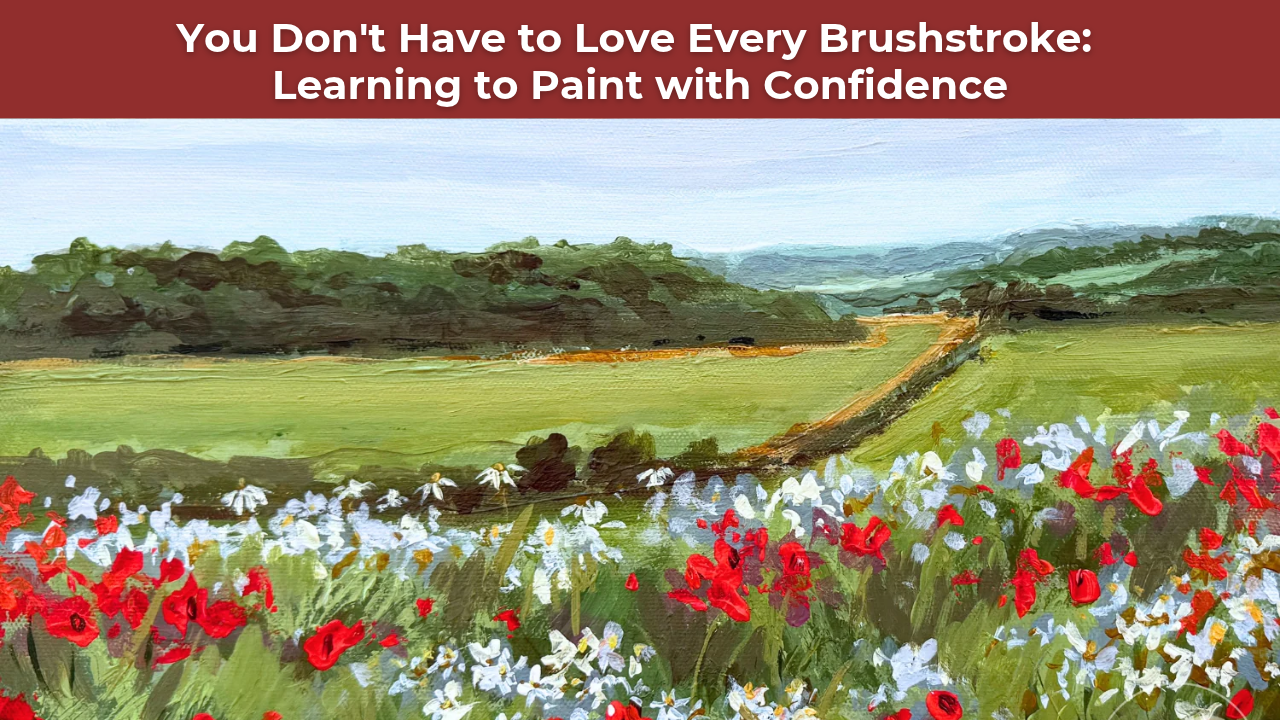
While filming our Wildflower Meadow tutorial inside Studio B Art Club, I found myself making plenty of adjustments throughout the painting process.
The painting began with loose layers of color to establish the landscape.
At that stage, there weren't any beautifully defined flowers or delicate grasses. I was simply building the foundation.
As I began adding wildflowers and grasses, I made marks that I loved.
And I made some that I didn't.
Sometimes I'd put down a brushstroke and immediately think, Nope. That's not working.
So I'd change it.
I might smudge the paint, adjust the color, break up a shape, or paint over an area entirely.
And then I'd keep going.
The painting developed through a series of decisions, adjustments, and layers.
That's what I want artists to understand: painting is a process, not a performance where every mark has to be correct.
What to Do When a Brushstroke Doesn't Work
When you're learning to paint, an unexpected brushstroke can feel like a big setback.
But instead of assuming you've made a mistake that can't be fixed, I want you to start thinking about what you can do next.
Here are a few approaches I use regularly in my own paintings.
1. Smudge It
Sometimes a brushstroke feels too sharp or defined.
Rather than removing it completely, try softening the edge or gently blending it into the surrounding paint.
This can be especially helpful when painting loose landscapes, grasses, and flowers.
A mark that initially felt distracting might become a beautiful transition between two areas.
2. Paint Over It
One of the things I love most about acrylic painting is the ability to build layers.
If a mark isn't working, you can often let it dry and paint right over it.
You don't have to keep something simply because you've already spent time creating it.
Sometimes covering an area is exactly what the painting needs.
3. Break Up the Shape
If an area feels too heavy or repetitive, try introducing smaller marks or different colors to break it apart.
For example, in a wildflower meadow, a large patch of green might feel flat until you introduce touches of lighter greens, darker values, or small floral shapes.
Those additional marks can create movement and variety.
4. Change the Color
Sometimes the shape of a brushstroke is perfectly fine, but the color isn't working with the rest of the composition.
Before painting over the entire area, consider whether a simple color adjustment could solve the problem.
You might need something warmer, cooler, lighter, darker, or less saturated.
5. Leave It Alone for a Moment
Not every brushstroke needs to be evaluated immediately.
Sometimes an area that looks strange in the early stages of a painting makes perfect sense once the surrounding colors and shapes are developed.
Step back and give yourself a little time before deciding whether something needs to change.
You might discover that the mark you were about to correct actually adds something interesting to the finished painting.
Confidence Comes From Knowing How to Make Adjustments
I think we sometimes assume that confidence comes from reaching a point where we rarely make mistakes.
But in my experience, that's not how it works.
Confidence comes from knowing what to do when something doesn't go according to plan.
When you're first learning to paint, a brushstroke that doesn't work might make you want to start over.
But the more you practice, the more you begin to recognize that very little on a canvas is permanent.
You can edit.
Adjust.
Layer.
Try again.
And slowly, the thought "I messed it up" begins to change.
Instead, you start asking:
"Okay. What does this painting need next?"
That shift in mindset makes an enormous difference.
You become more willing to experiment because you're no longer afraid of making the wrong decision.
You begin trying new colors, using more expressive brushwork, and taking creative risks.
And that's often when your paintings become more interesting.
Why Working Through Mistakes Makes You a Better Artist
One of the things I emphasize inside Studio B Art Club is that learning to paint involves much more than following instructions.
Yes, we create beautiful artwork together.
But along the way, I'm also talking you through why I'm making certain decisions.
What I'm noticing.
What I decide to change.
And how I work through the parts that aren't quite working yet.
Because ultimately, I don't want you to feel like you can only paint when someone is telling you exactly where to put your brush.
I want you to develop the confidence to approach your own subjects and make those decisions for yourself.
And that confidence comes from experience.
Every time you recognize a problem and work through it, you're developing your artistic eye.
You're learning how colors interact, how shapes relate to one another, and how to evaluate your painting as a whole.
Those are skills that will stay with you long after you've finished a particular tutorial.
Keep Painting, Even When It Isn't Perfect
The next time you're working on a painting and something doesn't go the way you intended, I want you to remember something.
You don't have to love every brushstroke.
You don't have to get every color right the first time.
And you certainly don't have to know exactly how your painting will turn out before you begin.
Sometimes you'll make a mark and immediately know it needs to change.
Other times, you'll discover that an unexpected brushstroke becomes one of your favorite parts of the painting.
Both experiences are valuable.
The goal isn't to avoid making mistakes. It's to become confident enough to keep painting after you make one.
So put down the brushstroke.
Step back.
Evaluate what you've created.
And keep going.
Because every adjustment is another opportunity to learn something about your painting.
Build Your Painting Confidence in Studio B Art Club
If you'd like to develop these skills alongside me, my Wildflower Meadow acrylic painting tutorial is available inside Studio B Art Club.
Throughout the lesson, I demonstrate how to build a colorful landscape through loose layers, expressive brushwork, and intentional adjustments.
Inside Art Club, you'll find a growing library of step-by-step acrylic painting tutorials designed to help you understand not just how to paint, but why certain artistic decisions work.
My goal is to help you become a confident, independent artist who feels comfortable experimenting, making changes, and creating artwork that feels uniquely your own.
Want More Weekly Art Tips?
If you found this helpful, you’ll love our exclusive weekly art tips delivered straight to your inbox! Sign up below to get insights, painting techniques, and creative inspiration—plus first access to exciting opportunities inside Studio B.
We hate SPAM. We will never sell your information, for any reason.